Puffy Jelly: The Ultimate Bubble Graffiti Font for Bold Projects
There’s a certain electric feeling you get when you see a design that refuses to be ignored. It’s that moment when the visual noise of the internet fades away, and one specific image screams for your attention. For designers, entrepreneurs, and creators, achieving that level of "stop-the-scroll" power is the holy grail of visual communication. We often look for complex solutions—elaborate illustrations or intricate layouts—when sometimes, the answer lies in the fundamental building blocks of our design: the typography. If your current projects feel a bit flat, lifeless, or simply too corporate for the vibrant message you want to send, it might be time to inject some serious energy into your toolkit.
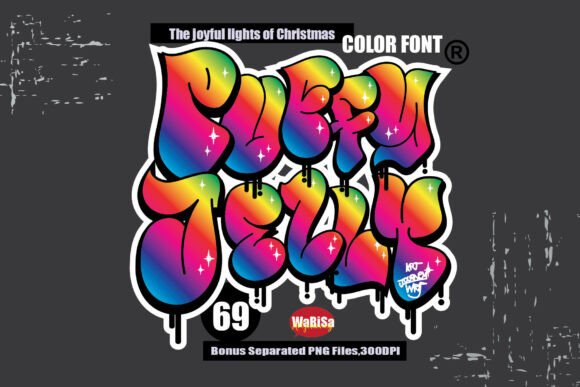
Enter Puffy Jelly, a typeface that doesn't just sit on the page; it leaps off it. This isn't your standard sans serif font or a delicate script. Puffy Jelly is a premium display typeface defined by its massive, bubbly, and drippy letterforms. Inspired by the raw, expressive nature of urban graffiti and throw-up style, it captures the chaotic beauty of street art but packages it into a usable, digital format. The visual appeal is immediate: imagine letters that look like they are made of shiny, elastic jelly, inflated to the point of bursting. The defining characteristic is the pre-applied, high-contrast rainbow gradient fill combined with white sparkles. This combination creates an incredible three-dimensional effect that mimics the look of glossy, reflective material under studio lighting. It is purely decorative, designed for maximum visual impact, and it brings a youthful, energetic aesthetic that is hard to replicate with standard vector shapes.
Why Color Fonts Are Changing the Game for Branding
For years, designers have been limited to flat colors when working with type. We would spend hours adding gradients, shadows, and highlights to text to give it depth. However, modern typography has evolved with the introduction of OpenType-SVG technology. Puffy Jelly is an advanced color font, meaning the vibrant gradients and the "jelly" texture are built directly into the glyphs. When you type a letter, you aren't just getting a vector outline; you are getting a high-fidelity graphic element instantly. This is a massive advantage for brand identity and visual consistency. Whether you are designing on a high-end desktop application or a tablet, the effect remains consistent, saving you valuable production time.
This technology is particularly crucial for anyone working in the digital space. Social media graphics are the frontline of modern marketing, and the algorithms favor content that generates engagement. A standard, safe font often blends into the background noise of a user's feed. In contrast, the Puffy Jelly typeface utilizes that glossy, dripping rainbow aesthetic to trigger an emotional response—fun, excitement, and nostalgia. It reminds us of 90s aesthetics, arcade games, and the playful side of pop culture. If your brand voice is loud, confident, and youthful, this font acts as an instant visual shorthand for those values.
Practical Applications: From Streetwear to Digital Products
Understanding where to use a creative font like this is just as important as having it. Because Puffy Jelly is a display font, it is not designed for body text or long paragraphs. Its strength lies in headlines, logos, and accents. Here is how different professionals can leverage this asset:
- Logo Design and Branding: For businesses in the entertainment, fashion, or lifestyle sectors, a logo sets the tone. A streetwear brand, a youth club, or a DJ collective can use Puffy Jelly to create a logo that feels authentic to the street-culture roots. The "puffy" 3D effect gives the logo a tactile quality, making it feel like a sticker you want to peel off the screen.
- Event Posters and Marketing Assets: If you are promoting a music festival, a rave, a carnival, or a birthday bash, the typography needs to convey energy. This font screams "party." Using it for the headline of a poster or a flyer instantly communicates the vibe of the event without needing to read the sub-copy.
- Merchandise and Packaging Design: Physical products benefit immensely from this typeface. Imagine this font printed on tote bags, hoodies, or sticker packs. The visual style translates well to print, especially when using the included transparent PNGs. For packaging design, particularly for candy, toys, or energy drinks, the "jelly" texture suggests something sweet and fun.
- Video Game Titles and UI: The gaming industry thrives on immersive visuals. Puffy Jelly fits perfectly into casual mobile games, retro-style platformers, or streaming overlays for gamers. It adds a layer of polish and thematic consistency that enhances the user experience.
Integrating Puffy Jelly into Your Design Workflow
One of the biggest hurdles with unique design assets is versatility. A common concern is that a font this distinct might be difficult to use in professional software. However, Puffy Jelly is engineered for ease of use. It is compatible with major design platforms including Photoshop, Procreate, Canva, and Illustrator. Because it is PUA-encoded (Private Use Areas), accessing all glyphs, swashes, and alternate characters is effortless, even if you don't have advanced OpenType features in your specific software. This means you can easily swap out a standard "A" for a stylistic alternate that might have extra drips or a different angle, allowing for true customization.
Furthermore, the inclusion of separated PNG files is a significant value-add. While the font file works great in supported apps, having high-resolution raster images of each letter with transparent backgrounds offers limitless flexibility. You can drag and drop these letters into software that doesn't support color fonts, or you can manipulate them individually—rotating, scaling, or layering them—to create a custom typographic lockup. This is particularly useful for packaging design or complex editorial layouts where you need the letters to interact with other graphic elements in a non-linear way.
Mastering Font Pairing and Readability
When working with a bold display typeface, the most critical skill is knowing what to pair it with. Because Puffy Jelly is so visually "loud," it demands a quiet partner. If you pair it with another decorative, handwritten, or modern serif font, the result will be visual clutter that confuses the reader.
The best strategy for font pairing here is contrast. To maintain readability and professional presentation, pair Puffy Jelly with a clean, geometric sans serif font for your body text. Fonts like Montserrat, Roboto, or Open Sans provide the neutrality needed to let the headlines shine. For example, if you are designing a website header, use Puffy Jelly for the main title to grab attention, then switch to a simple sans serif for the subtitle and the call-to-action button. This hierarchy guides the reader's eye naturally from the exciting headline to the informative content.
Another practical tip is to pay attention to spacing. Because the letterforms of Puffy Jelly are "puffy" and often feature drips or swashes that extend beyond the standard bounding box, you may need to adjust your kerning (the space between letters) manually. Ensure that the letters aren't colliding with one another, which could muddy the design. Also, consider the background. While the rainbow gradient is vibrant, it works best against high-contrast backgrounds—either a stark white for a pop-art feel or a deep black/dark grey to make the colors glow like neon lights.
Choosing the Right Typeface for Your Audience
Typography is subjective, but it is also strategic. Choosing a font like Puffy Jelly should be a deliberate decision based on your target audience. If your demographic is Gen Z or Millennials who appreciate irony, nostalgia, and bold aesthetics, this font is a perfect match. It communicates that your brand doesn't take itself too seriously and values fun. However, if you are a corporate law firm or a medical provider, this style would likely undermine your credibility.
For small business owners and entrepreneurs, the key is to align your typography with your brand's personality. Ask yourself: Is my brand loud or quiet? Is it traditional or rebellious? Is it luxurious or accessible? Puffy Jelly answers "loud," "rebellious," and "accessible." It is the typographic equivalent of turning up the volume at a party.
Before finalizing a project, always test your designs. Show a mockup of your poster, logo, or social media graphic to a few people in your target demographic. Does the font resonate? Does it convey the intended emotion? Does it distract from the message? In the case of Puffy Jelly, you will likely find that it draws the eye immediately, which is exactly what a headline font is supposed to do.
Final Thoughts on Elevating Your Visuals
In a crowded digital landscape, blending in is the kiss of death for a brand. You need tools that allow you to stand out quickly and effectively. The Puffy Jelly color font is more than just a set of letters; it is a pre-packaged visual style. It combines the rebellious spirit of graffiti with the polish of modern digital design. By utilizing its built-in gradients and 3D effects, you can create marketing assets, merchandise, and digital products that look complex and high-effort, even if the execution was surprisingly simple.
Whether you are a content creator looking to spice up your thumbnails, a graphic designer working on a festival poster, or a creative entrepreneur launching a new product line, this typeface offers a unique solution to the problem of visual boredom. It reminds us that design should be fun, expressive, and sometimes, a little messy. So, if you are ready to explode with color and energy, it might be time to let your typography get a little puffy.