Arxenon: The Geometric Font for Modern Tech and Design
You’re staring at a blank artboard, trying to nail down a visual identity for a new SaaS product or a sci-fi indie game. You know you need something that screams "future" without looking like a relic from a 1980s arcade. This is where the typography dilemma usually hits: most futuristic fonts are either too illegible to be functional or too plain to be interesting. Finding that sweet spot—where geometry meets readability and style meets substance—is rare. When you find a typeface that bridges that gap, it changes how you approach design entirely.
The Geometry of a Digital Frontier
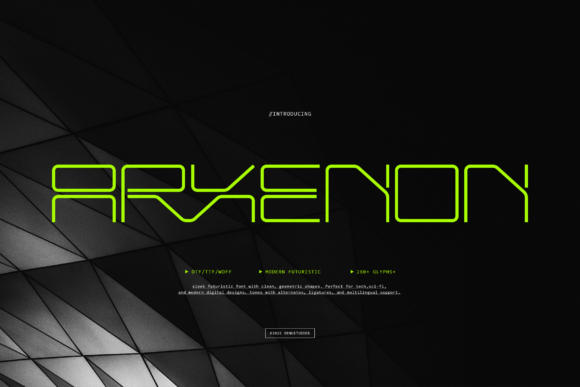
Arxenon isn't just another display font; it is a study in controlled precision. If you look closely at the letterforms, you’ll notice it doesn't rely on the soft, organic curves we see in humanist sans-serifs. Instead, it embraces clean, geometric lines and sharp angles that feel engineered rather than handwritten. This gives it a distinct, polished aesthetic that works incredibly well for brands that want to convey innovation, logic, and efficiency.
The "futuristic" label often gets thrown around too loosely in typography, but Arxenon earns it through its minimalist curves. There is a sense of movement in the characters, even though they are static. It avoids the trap of being overly decorative, which means it remains legible even when used at smaller sizes or on screens with varying resolutions. For anyone working in web design or digital interfaces, this is a critical factor. You need a typeface that loads quickly visually and doesn't fatigue the reader's eyes.
Beyond the Screen: Where Arxenon Shines
While the description suggests it is perfect for tech branding, the versatility of Arxenon extends much further than just software dashboards. Its high-contrast structure makes it a powerhouse for poster design and packaging design. Imagine this font on a matte black box for high-end headphones or a vibrant event flyer for a tech conference. The sharp angles cut through visual noise, grabbing attention instantly.
Here is a breakdown of where this typeface can solve real-world design problems:
- Logo Design & Brand Identity: Because the letterforms are so distinct, Arxenon creates memorable logos. It helps a brand look established and serious about its aesthetic.
- Game Titles & UI: If you are designing a user interface for a game or an app, this font provides that necessary "digital" feel without sacrificing the clarity needed for menu items and instructions.
- Social Media Graphics: In the fast-scrolling environment of Instagram or TikTok, you have milliseconds to make an impact. The bold, geometric nature of Arxenon stops the thumb. It is excellent for quote graphics, headers, and promotional banners.
- Merchandise: T-shirts and hats often suffer from fonts that look great on a computer but turn into a blob of ink on fabric. The clean lines of Arxenon hold up well in screen printing and embroidery.
Strategic Pairings and Readability
One of the most common mistakes I see in modern typography is using a heavy, stylized display font for body copy. Arxenon is a premium font designed for impact, meaning it is best used for headlines, sub-headers, and call-to-action buttons. You wouldn't want to write a 500-word blog post in it, as the geometric shapes might tire the eye over long paragraphs.
Instead, you need to master the art of font pairing. To let Arxenon truly pop, pair it with a clean, neutral sans serif font or a classic serif font for your body text. For example, if you are designing a magazine layout or an editorial design piece, using a standard serif like Georgia or a modern sans-serif like Roboto for the paragraphs will create a beautiful hierarchy. The contrast between the futuristic Arxenon headers and the traditional body text creates a rhythm that feels professional and easy to read.
Unlocking Potential with OpenType Features
What separates a standard typeface from a creative font toolkit is usually found in the OpenType features. Arxenon comes equipped with alternates and ligatures. If you aren't using these, you are missing out on half the value.
Ligatures combine two specific characters (like "fi" or "st") into a single, fluid shape, which eliminates awkward spacing and adds a custom feel to the text. Alternates allow you to swap out standard letters for stylistic variations. This is particularly useful for logo design or hero text on a website where you want a specific letter to stand out or connect in a unique way. It allows you to customize the typography so that your project doesn't look like a template.
Additionally, the multilingual support is a non-negotiable feature for global brands. If you are launching a product in Europe or South America, you need to know your typeface can handle accented characters and special punctuation without breaking the visual flow. Arxenon handles this seamlessly, ensuring your brand identity remains consistent across different languages and markets.
Making the Decision: Is This Your Next Brand Font?
Choosing a font is a business decision as much as an artistic one. When you select Arxenon, you are positioning your brand in the "innovation" lane. It tells your audience that you are forward-thinking, precise, and modern.
Before you commit, I always recommend testing. Take the font and mock up your actual assets. Don't just look at the alphabet; type out your actual business name, your tagline, and a sample of your marketing copy. Check how it looks in all caps versus lowercase. Test it on a dark background versus a light one.
Finally, consider the licensing. Since Arxenon is a commercial font, ensure you understand the terms for your specific use case—whether that is a single desktop license for print work or a webfont license for your site. Investing in a quality typeface like this signals to your clients and customers that you care about the details. It’s the silent ambassador of your brand, and having the right one makes all the difference.